Come for the Politics, Stay for the Pathologies


Sunday, November 8, 2009

Jumping Jills

Because it’s been a heavy-lifting week, here’s a Sunday treat. Grab a bagel and a cup of joe. Sit back, crank up the volume and enjoy this youthful explosion of athleticism and musicality.

These are the Kings Firecrackers, 4th through 8th grade girls from Cincinnati, performing at this year’s Army-Navy basketball half-time show.  Yes, with jump ropes! It runs long, but I promise you’ll be riveted. And when you’re finished, you’ll feel better about everything.


Feminists everywhere who still want girls to participate in boys’ wrestling and football teams will be appalled. Frankly girls,  life accelerates to the block, tackle and headlock phase soon enough. Best to have some fun while preparing.

I defy anyone to tell me that these girls are less fit, disciplined or competitive than their football playing brothers.

H/T Margo


Saturday, November 7, 2009

Weekly Review in Dew Points

Random thoughts from the week:

  • H1N1 vaccine was sent to Wall Street firms by New York City government health authorities while little children and pregnant women are still waiting in line. We wouldn’t want Barry’s Banks to sneeze now, would we? We all remember what happened last time.

But this shouldn’t raise any flags or concern about how health care rationing will operate when we get Obama-care.

  • Allahu akbar! Fort Hood monster “likely” shouted “Allahu akbar” (Allah is Great) before his terrorist rampage. Interestingly, so did Sulejman Talović, the shooter at the Trolley Plaza mall in Salt Lake City who killed 5 and wounded 4 in 2007 before being taken out by police. Oh, and he was a member of a fundamentalist mosque right around the corner from the mall. He received a hero’s funeral when returned to his native Bosnia for a proper Muslim burial. But you probably didn’t hear much about any of that. The self-censuring MSM decides how much of the truth you can handle.
  • Cash for Clunkers may not save  Barry’s Autos, but it did provide a nice little boost for Sirius XM radio, whose 3rd quarter numbers reported the first uptick in the number of new subscribers since last year. Probably due to the free introductory subscription you get with a new car purchase. The company warns that things are likely to drop off in the 4th quarter. But hey – another million jobs saved or created!
  • The city of Detroit also reports a significant increase in jobs saved or created in some of the few remaining growth industries inside the city limits: urban explorers, firebugs and demolition specialists.
  • BHO will be going up to the Hill today to persuade his loyal followers to vote for his (and Nancy’s) Health care bill. The basic theme of the little pep talk will be “Trust me. Words don’t really matter.” This will be a follow-up on a round of discussions last week conducted by Rahm ‘Steel-Balls’ Emanuel  with squeamish House members. He advised them to just vote yes, because the bill was going to be changed to everyone’s liking later on anyway. ‘Steel-balls’ figures that since they sold the rest of the world on the “vote for change” concept, they can surely get this batch of rubes to come around.
  • Also in White House news: BHO conducted his traditional happy hour at the White House on Friday. Some thought it odd that he didn’t fly out to Texas to console the survivors and comfort the relatives of the deceased. But hey, it’s not like some right wing extremist opened fire on a mosque in Detroit, or some other such tragedy that would require the President’s attendance. This particular slaughter didn’t offer much opportunity to apologize for America.
  • I would be remiss if I didn’t mention Barney Frank. He had to leave the floor of the House to answer some pesky questions related to a pot bust at the Maine home of his boyfriend back in 2007 in which pot plants, bongs and other paraphernalia was confiscated. This would probably be old news, but for the fact Barney’s sponsoring a bill that appears to legalize marijuana. But don’t worry, Barney tells us that he wouldn’t recognize a bong if it hit him. And I believe him. It seems he’s easily “twicked” by people with less than sterling intentions; like his friends at Fannie Mae and Freddie Mac. Here’s a nice, concise history of how he was “twicked” by the organizations that later gave him hundreds of thousands of dollars in campaign contributions.

Barney, what are we to believe? Either you’re stupid, or you were stoned.

I presume pot will be included in the mental health coverage of our new health care plan.


Wednesday, November 4, 2009

Detroit, Back to Its Roots

There is something innate in human nature that draws our gaze to an impending train wreck, and maintains our slack-jawed attention as we gape at its aftermath. It’s like that with Detroit, which has been voted the worst train wreck in the “major American city” category. Journalists, artists and bloggers from across the world come to look at, photograph, write about and paint us. Then they go home to wring their hands and weep over our detritus.

Consider an interesting fact about Detroit: it’s huge, even by city standards. 140 square miles. Manhattan, Boston and San Francisco could all fit comfortably within the borders of Detroit and still have room left over.
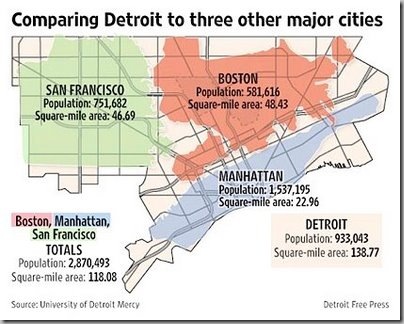
detroit plan three Images from Urbanophile

There are approximately 40 square miles –essentially the size of San Francisco - within the city that stand empty (see previous post, “Feral in Detroit”). That number’s likely to increase as the city’s population continues to decline from it’s peak of  nearly 2 million in the 1950’s to it’s current 800,000, to an estimated 600,000 by 2025. The problem of course is that today within the 140 square miles there exists a very low density of any type of industry or businesses. So few in fact that there is not so much as a single chain grocery store, Wal-mart or Costco. Of course that’s hard to believe, but believe it. While there may be a market for product, issues such as crime, city services and extortionist tax rates keep retailers away like the plague.

The question of course is what to do with a city that has crumbled both literally and figuratively? Popular recommendations among urban planners and social engineers include “shrink to fit” plans, and “return to your roots.”  Allow me to translate: recognize that the city will never return to its glory days (the best is behind us), so we just have to make do the best we can by shrinking down (reduce our carbon footprint) and returning the land to its natural state (establish sustainable farms within the city limits.)

If that sounds  familiar it’s because it’s a slight variation on the liberal template for America: recognize the end of American exceptionalism, contract our economy and lifestyles, and leave a smaller carbon-footprint by learning how to live with only “green” sustainable energy. If I may borrow a phrase from our President, “that’s just bunk.”

There’s just something about me that does not like to settle.

Having said that, here’s the best argument for radical reductionism that I’ve seen to date: Detroit: Urban Laboratory and the New American Frontier. Aaron Renn, the Urbanophile and author, is not an academic urban planner, but has actually worked in the real world as a systems strategist. He has written a purposefully provocative article on how to deal with failed cities like Detroit, making painfully accurate assessments of what the changeup in the manufacturing sector in the rust belt means for the region. And while he touches on the leadership problem this major urban center has struggled with (both Detroit proper as well as regional) he hasn’t identified it as one of the most critical aspects of this city’s descent into the five rings of Hades. But in fact, ever since Coleman Young - lionized to this day - took the reins (or reigns) of power in the city it has been run by a self-serving Black Mafia. Negligent leadership has contributed as much to the city’s demise as the failure of the Autos and the anti-business climate of the state combined. The only good news is that proper leadership may end the slide and even commence the steep, difficult climb back to the surface. With Dave Bing’s win yesterday in Detroit’s mayoral election there is reason to believe that ascent is possible.

But back to Mr. Renn’s piece; it is provocative. And useful for pointing out a few starting points on the path to redemption. His view does include a version of shrinkage and urban farming, although it stops short of  turning the entire urban landscape back to it’s agrarian roots. For that vision you need to go to Guernica: Food Among the Ruins  which is referenced in the Renn post. This is an equally provocative but more earnest argument for leveling miles of urban wasteland and returning them to the farms that stood here before Henry Ford imagined a world on wheels.

On its face the urban farm concept for a city as deeply scarred as Detroit holds a great deal of poetic appeal. After all, the city was built on rich, arable farm land that still lies beneath the structures. The once fertile fields were gradually annexed and filled with housing stock to meet the needs of a growing urban population that congregated around the industries that built America into the most powerful industrial giant the world had ever seen.  Now that this industrial base has crumbled, many Americans are experiencing a low level angst about our preeminence at anything other than having elected the smartest President since JFK. For them, it just feels right to rip up a forlorn city – emblematic of everything wrong with the past -  and return it to its roots, so to speak. An urban homage to agriculture: how post-modern, how ironic. How moronic.

But it is the circle of life. Poetic? I suppose. Pragmatic? Certainly. Practical? Not so much.

But let’s play along for awhile. Could it be accomplished? I would think so. You would have to tear up infrastructure that would cost a fortune to remove and an even larger fortune to relocate. Why bother to relocate you ask? Oh, I don’t know, perhaps because the entire 140 square miles includes grids of electric lines, gas and water mains, and fiber optic cable that are all interconnected, north to south, east to west. Just yanking them out where you want to grow organic Tuscan kale and heirloom tomatoes might cause downstream problems. Someone who still lives in one of the remaining “urban villages” might notice if they no longer have heat, lights water or cable TV.  I suppose you could tear up the streets and sidewalks if you no longer need them, although that’s where most of the cable, gas and water mains are buried. I’m sure we can work around that. But we’ll need some federal funds to help cover the costs.

Then of course there’s the toxicity created by 100 years of city life: dry cleaning plants, buried gas and oil tanks, god knows what else. Soil testing and bio-remediation would undoubtedly create thousands of jobs, so that’s a good thing. It’s just not cheap, so we’ll need some federal funds to defray costs. Oh, and forget about a USDA certified organic designation, even after remediation. Not going to happen.

But suppose everything works out. Suppose the two-story bee hives are humming, the escarole is waving in the breeze and the customers are buying the produce as fast as it can be harvested. Unless they are operating as non-profits, the current tax structure in the state as well as the city might become an issue. They’ll have to cover Detroit’s city income tax (highest in the state),  Wayne county’s property taxes (near the top) and the state taxes and levies  - also  among the highest in the country, no matter how our state’s public relations team tries to spin it otherwise. That might make farming, which has notoriously thin profit margins, a risky business without some tax subsidies. 

But hey, I hear you. I’m just being a nay-sayer, when what we really need around here are some visionaries.

urban villages

So I hope we can locate a visionary who sees the possibility of consolidating city services into the urban core and de-annexing the remaining clusters of  urban villages to the highest bidder, maybe on Craig’s list. If you win the bid, you can be mayor for 8 years and compete with your fellow mayors for state and federal funds to develop your village into enterprise zones where urban homesteaders might actually want to  live and work.


Tuesday, November 3, 2009

Feral In Detroit?

Why is it that people are so fascinated with the decline of our city? It’s not that Detroit is the only urban center beginning to collapse in on itself, Baltimore, Newark, Buffalo, St. Louis come readily to mind. But Detroit is different. Possibly there’s an element of schadenfreud attached to Detroit’s decline that both enthralls and repulses people. In the course of less than 50 years  –a blink in the history of a city - it plunged from the pinnacle of urban industrial prosperity to the depths of urban industrial decay: completely, indisputably, very likely irreversibly.

The latest article I’ve seen that focused on our urban nightmare is City Journal’s  Feral Detroit by Steven Malanga. He cites the phenomenon of abandoned neighborhoods being overrun by vegetation. The blog Sweet Juniper seems to have coined the termferal house detroit2 to  describe structures and even whole neighborhoods that are being reclaimed by untended vines, shrubs, trees and weeds. It contains a multitude of striking photos. Here is a small sample:

feral house det1

feral det hires

The City Journal article

references a paper done by Edward Glaeser and Andrei Shleifer that contends  Detroit’s population decline, fundamental to its demise, was largely a self inflicted wound, caused by the “Curley Effect”:

Though some blame Detroit’s population losses on larger economic forces, economists Edward Glaeser and Andrei Shleifer argue in a groundbreaking paper that the city’s problems are mostly self-inflicted. (The paper, called “The Curley Effect,” gets its name from legendary Boston mayor James Curley, who favored Irish residents and pushed other groups out.) After winning election in 1973, Detroit’s first black mayor, Coleman Young, consolidated his power, driving white residents, who had voted against him, out of the city by withdrawing services from their neighborhoods. Eventually, Glaeser and Shleifer write, Detroit became “an overwhelmingly black city mired in poverty and social problems”—and shrinking fast.

There is much to support this version of history, not the least of which is politicians’ predilection to reward supporters and punish opponents. But regardless of where you place blame, the result is incontrovertible, as demonstrated by these photos from discarded lies – hyperlinkopotomus:

First is an aerial photo showing the density of the neighborhood around St.Cyril’s Roman Catholic church and school on Detroit’s near East side in 1949.

StCryil1949A

The next illustrates the same area in 2003, the year St. Cyril’s was demolished creating an even larger urban prairie in the middle of the city.

St Cyril 2003

This is a photo of the ruins of St. Cyril just prior to demolition:

st Cyril before final destruction circa 2003

And here’s what stands in the near vicinity today:

st cyril detroit 2008photo from Detroit Liger

“Desolate” cannot begin to describe the emotional impact of a city that has come undone.

Tomorrow we’ll cover a growing movement to return Detroit to its roots, so to speak.


Sunday, November 1, 2009

Burn Baby, Burn

Sadly, Detroit is best known to the world’s under-30 population for its decline, decay and danger. Few aspects of Motown life contribute to this image more than Devil’s night: which is actually a 3 day event that commences on October 29 and ends on Halloween.

Fire – Crazy World of Arthur Brown

devil1

Devil’s Night is Detroit’s relatively recent annual festival of fire: arson fires to be more specific. It’s this mixed bag of vandalism, insurance fraud, and normal every-day fires that captures the attention of amateur and professional “fire photographers” from around the world. This year, with its 27% unemployment rate and record high home foreclosure and abandonment rate (it is estimated that 40,000 homes were abandoned in the past year alone), Detroit stood poised to set a new record.

“Official” figures won’t be released until next week, and if previous guidelines are followed, many fires won’t make the final cut to be included as “official” fires. Rest assured however, that, no matter how many fires erupt, Detroit’s finest fire fighters will risk their lives extinguishing the blazes of Detroit’s deadly “urban renewal” project.

The city encompasses nearly a hundred thousand abandoned structures, all potential powder kegs of devil’s night mayhem. Despite that fact, the reality is

the city is in such financial ruin that the Detroit Fire Department now functions with nearly 300 fewer firefighters than a decade ago. Economic hardships coupled with a historic preference for cutting police and fire budgets rather than “essential” administrative and clerical staff has thinned the ranks of the DFD from 1,325 to 1,098.

Official DFD Devil's Night T-shirt 2009 Official Detroit Fire Fighter Devil’s Night T-shirt

Detroiters escalated the time honored traditions of trick-or-treat vandalism - home egging and mailbox assaults – to arson in the ‘70s. Over the next decade, financially troubled business’ and others with good insurance policies joined in the Devil’s Night fun for profit.

Detroit’s government officials did not sit idly by wringing their hands. First, former Mayor Coleman Young redefined the “overly broad” term fire to eliminate from reports fires that aren’t “really fires”. Then, in 1985, Mayor Dennis Archer and the city council leapt into action and rebranded Devil’s Night, “Angel’s” Night, hoping to change the tone and persuade evil doers to come to the city-sponsored Halloween parties instead of torching a city block. This, it was believed, would establish a new tone, engender a new respect for the evening; and reduce the number of “man caused disasters.” Even after redefining the “overly-broad” term “fires” and rebranding the night, the city’s bean counters had to commit “calculator abuse” in order to prevent or reduce the number of Devil’s Angel’s Night fires.

This year, Dave Bing, former Detroit piston star, successful business owner and current Detroit Mayor, realized that a new moniker won’t keep the hell-raisers from lobbing Molotov cocktails into abandoned homes and warehouses. He’s recruiting Detroiters to join New York’s Guardian Angels and thousands of volunteers from across America to patrol the neighborhoods looking for signs of trouble.

The election next Tuesday will reveal if Detroiters are willing to put Dave Bing in office for a full term to continue his efforts to reform the city. Or will they vote to continue the steady decline of the last 40 years of failed leadership, hoping to get some of that stash of Obama money to fix everything..

Linked By: Wikipedia, Thanks!